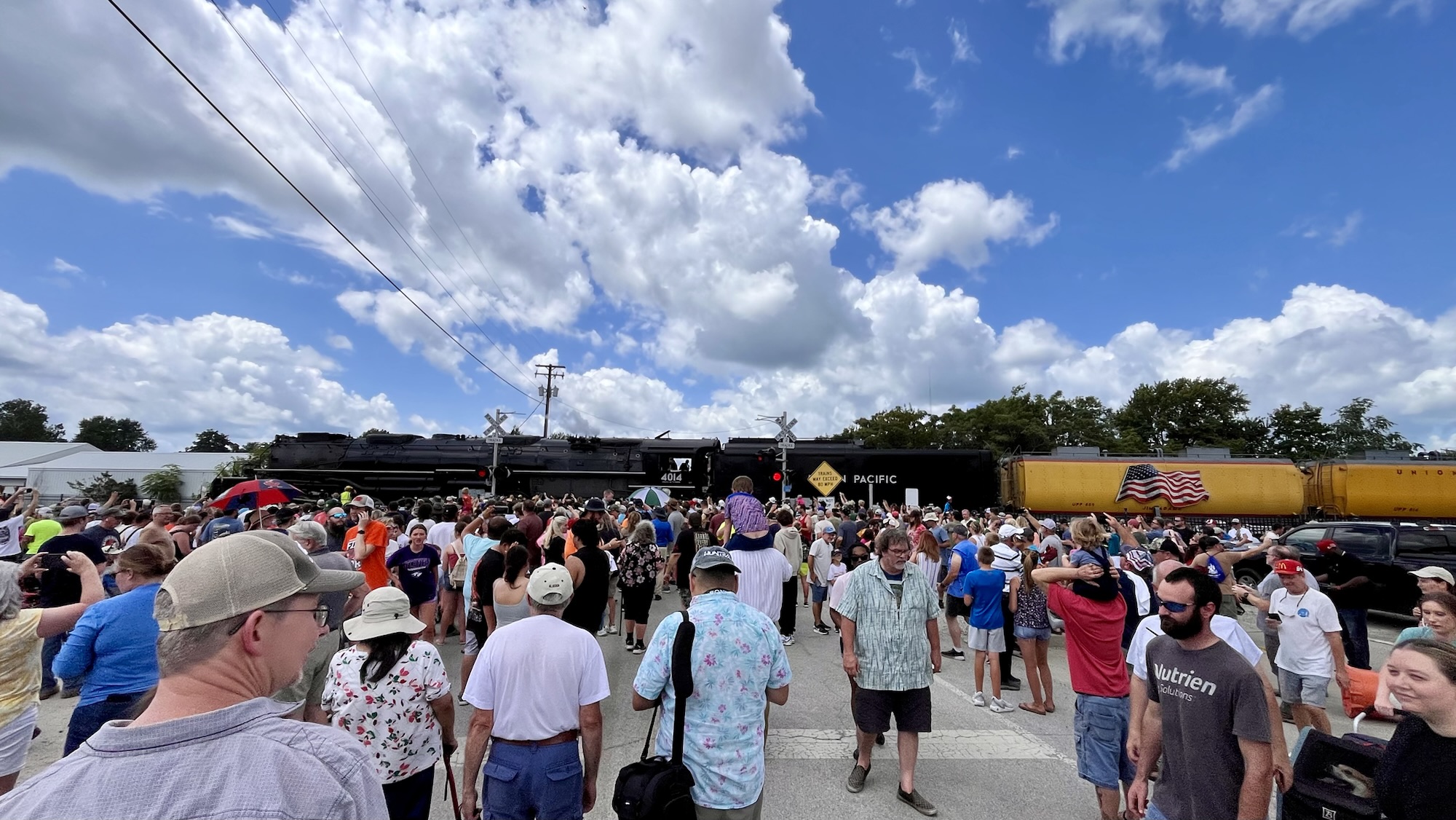
Below is some fun historical information. Skip down to THE FUN STUFF if you already know it!
Union Pacific’s Big Boy No. 4014 is the largest operating steam locomotive in the world and stands as a veritable visage of American railroading’s golden age. Built by the American Locomotive Company (ALCO) in November 1941, it was one of twenty-five “Big Boy” locomotives created at a critical moment in history, when the United States required unprecedented freight capacity to support wartime production and logistics during World War II. These locomotives played a vital role in hauling massive quantities of raw materials, fuel, and military supplies across the nation, particularly over the steep grades of the Wasatch Mountains between Utah and Wyoming, where their immense power proved indispensable.
Weighing more than 1.2 million pounds, or approximately 600 tons, with its tender, the 4-8-8-4 articulated locomotives represented the pinnacle of American steam engineering innovation. Big Boy No. 4014 is capable of approaching 6,290 drawbar horsepower at around 40 mph, with peak output estimates approaching 7,000 drawbar horsepower under ideal conditions. At the cylinders, its indicated horsepower has been estimated at roughly 8,000 to 8,150 horsepower. This immense power was paired with an exceptional tractive effort of over 135,000 pounds, allowing the locomotive to haul thousands of tons over steep grades without assistance. Its advanced design combined brute force with operational flexibility, showcasing the ingenuity and industrial strength that defined the era. The Big Boy class pushed the limits of size, power, and efficiency at a time when railroads were the backbone of the nation’s economy and war effort.
After retiring from regular service in 1961, No. 4014 spent more than fifty years on public display, serving as a monument to a transformative period in transportation history. Its return to the shops in 2013 marked the beginning of an ambitious restoration project, culminating in its triumphant return to operation in 2019. Today, Big Boy No. 4014 runs under its own steam, serving as a living testament to American engineering excellence and preserving the legacy of steam power. It’s history-make excursions allow America’s youth to witness firsthand one of the most significant achievements in railroad history and American intellectual prowess.
Following No. 4014’s tracks, other legendary steam locomotives are experiencing revitalization and resurrection efforts. Union Pacific’s Challenger No. 3985, a 4-6-6-4 articulated locomotive and close relative of the Big Boy, has undergone extensive rebuilding work with the goal of returning it to operation. While slightly smaller, the Challenger class was still immensely powerful, capable of producing roughly 5,800 to 6,000 drawbar horsepower and serving as a versatile high-speed freight and passenger locomotive. Meanwhile, the Pennsylvania Railroad’s T1 class—iconic 4-4-4-4 duplex locomotives known for their striking streamlined design—is being recreated from the ground up by the T1 Trust. The new-build T1 No. 5550 is projected to produce in excess of 6,500 indicated horsepower, potentially rivaling or exceeding the performance of many historic steam locomotives. Together, these efforts highlight a broader movement to preserve and revive the most powerful machines of the steam era, ensuring their stories and capabilities continue to inspire future generations.
America’s largest steam locomotives were each built with a distinct purpose, and their specifications highlight these differences.
The Big Boy was the brute-force specialist. Its monstrous weight, sixteen driving wheels, and roughly 135,000 pounds of starting tractive effort allowed it to move exceptionally heavy freight trains over Union Pacific’s mountain grades.
The Challenger traversed more versatile middle ground. It was smaller and lighter than the Big Boy, but it handled freight at relatively higher speeds. Challengers were also used on some passenger trains, something for which the Big Boy was not initially intended.
The T1 was built for true speed rather than maximum pulling force. Its 80-inch drivers, streamlined body, duplex drive, and approximately 6,500 indicated horsepower were intended for sustained high-speed passenger operation. It produced less starting tractive effort than either Union Pacific locomotive, but it could develop tremendous power once moving at speed.
Together, these three locomotives represent the pinnacle of American steam engineering, illustrating how designers pushed the limits of steam technology in different directions to meet specific operational demands. The Big Boy emphasized sheer tractive force and mass to conquer mountainous terrain with unprecedented freight loads, while the Challenger balanced power and speed to handle a wider range of duties efficiently. In contrast, the T1 prioritized aerodynamic design and high-speed performance by sacrificing raw pulling power to excel in fast passenger service. This clear contrast in design goals—maximum power, operational flexibility, and sustained speed—demonstrates the remarkable adaptability and ingenuity of American locomotive engineering at its peak.
THE FUN STUFF
Girard held a special festival for No. 4014’s visit, and part of that meant cordoning off many roads and whole city blocks. Certain spaces like fields, grassy areas, and a school parking lot were used for specific shuttle waypoints. THAT was a phenomenal idea!!! It offered a safe route to and from the Big Boy site, mitigated traffic of an estimated 1,000 people, and it offered an air conditioned ride on a hot day. There were also smaller transportation modes available, such as golf carts and moderately sized utility vehicles.


Tom and I had a great day out with the Big Boy. I had never met Tom until that day. He follows the Crawford County Model Railroaders on Facebook, and he responded when I offered to carpool to Girard with club members. He lived an hour north of Charleston, Illinois, and I lived an hour south of Charleston. We met in the Charleston Walmart parking lot and took my truck to Girard. I’m glad we got along well for that two and a quarter hour, one-way drive!