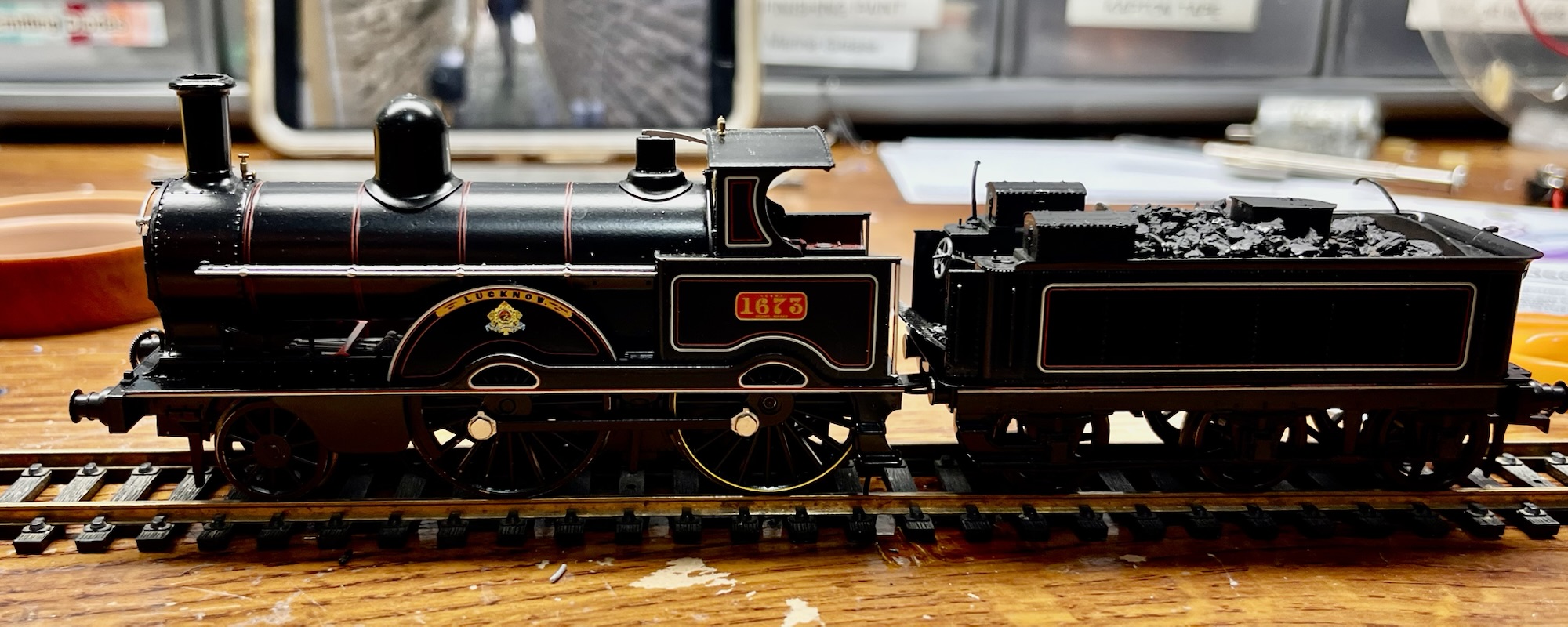
A club member brings me interesting models for upgrade. This time, he brought me a very new British model and a very old American model.
My friend and fellow club member collects largely British models. This time, he had me upgrade a stout little 2-6-0 steam locomotive manufactured by UK Bachmann. It was made mostly well, but their use of the 21-pin decoder system annoyed me. These little steamers’ little tenders need room for a decoder, a speaker, and a capacitor. 21-pin decoders are thin but wide, and their connectors make their geometry taller than necessary. I removed that in lieu of a TSU-1100. Doing so left plenty of room for a capacitor. A speaker was already inconspicuously supplied within the bottom of the tender. With plentiful space, the hard wiring was a breeze!
These thin little power wipers bend and break easily. Flexing them back into shape takes care.Real coal pieces were glued to the tender upon receipt by my client, so my work bench was fifty percent covered with it.
My client brought me another model dating to 1975. It is a well-known Tyco Chattanooga, known for little quirks, engine mechanism problems, and general finickiness. It’s a reputation well earned!
These Chattanoogas are tender-driven rather than engine driven. The blocky motor draws power from the tender frame and the engine drivers.To improve electrical continuity, I added custom-formed axel wipers made from Kato N scale diesel truck wipers. There were two springs within the old, dilapidated smoke unit, and they were perfect for pressing the metal axel and wheel against the movable axel frame. These tenders have plentiful space for the PowerTorque pancake motor block.I installed a TCS KA5 in this model since I had ample space. The improved electrical continuity is still only so good, so the largest capacitor I have is appropriate.All that space was great for housing the decoder and capacitor. A metal screw connected a motor brush and spring to the frame, so I removed that and used UV hardening gel to replace the screw and keep the frame and armature mechanism plate together.
There was no working backlight in the tender from the manufacturer, so I melted a hole into the fake backlight to make room for an LED. That’s not bad for a fifty-one year old model!